Sunday, October 19, 2014

A Woodie in the Magnolia

I was taking our dog for a walk. Cosmo stopped to sniff something. I looked up into the top branches of our Magnolia tree. A bird was rustling in the leaves. We have a Northern Mockingbird there sometimes. This time it was the beautiful Red Bellied Woodpecker.

The Red Bellied Woodpecker is strictly an eastern bird. We did not see it in northern California. There we saw the Acorn Woodpecker and the Nuttal's Woodpecker. They will have to come to the eastern United States to see the Red Bellied Woodpecker.

E-bird's Map for Red Bellied Woodpecker Sightings

Robert and Berry

photo courtesy of weeksbay.org
map courtesy of ebird

Monday, October 6, 2014

Home from San Francisco

Leaving San Francisco

We woke up to a chilly, foggy morning. We packed the suitcases which were very heavy because we had to put everything in them to take home. In the parking lot of the hotel as we were loading our bags into the car for the final time, a flock of twelve Canada Geese flew directly over us, honking loudly. They were flying low due to the foggy conditions, but it seemed like they were saying farewell to us on our last day here.

To finish our blogging of this birding trip to San Francisco, Berry and I have decided to draw up a short Pop Quiz about the last twelve blog posts. This will be multiple choice. It is also an open-blog Quiz, that is you can look back at older posts to find an answer.

Please send us your answers in the Comment Section.

Pop Quiz

Question One : Whose luggage was lost on the flight from Memphis to San Francisco ? If you have been reading the blog, this should be easy.

A. Berry
B. Robert
C. All of the above
D. None of the above

Question Two : What was the first “Life Bird” of the trip ?

A. American Robin
B. Northern Cardinal
c. Whooping Crane
D. Red Shafted Northern Flicker

Question Three : What was the large, white bird we kept seeing, but usually is never found in northern California ?

A. Western Gull
B. American White Pelican
c. Mute Swan
d. Great Egret

Mute Swan Cygnus Olor

Question Four : What color is the beak of the Black Oystercatcher ?

A. Yellow
B. Green
C. Black
D. Orange

Question Five : Where was the sea cave that Berry tried to push Robert into ?

A. Point Reyes
B. Russian Gulch State Park
C. Golden Gate Bridge
D. Sausalito, CA

Question Six : Which of the following is not a potential danger in northern California ?

A. Mountain Lions, which eat you
B. Rutting Elk, which gore and stomp you
C. Tsunamis which drown you
D. Extraterrestrial aliens landing in California

Question Seven : Where at Lewiston Lake was the Bald Eagle ?

A. Right above our car
B. In a tree by the roadside
C. Fishing in the water
D. None of the above

Question Eight : What is the only songbird that goes swimming ?

A. Golden Crowned Sparrow
B. American Dipper
C. Bushtit
D. Western Scrub Jay

American Dipper Cinclus Mexicanus

Question Nine : When the back of the bird is patterned like a black and white ladder, it is called :

A. Wing Bars
B. Red Crested
C. Ladder Backed
D. Golden Crowned

Question Ten : In its interview, what question was asked of Mr. Black Necked Stilt ?

A. What do you eat ?
B. Can you find pants that fit you ?
C. Do you have a passport ?
D. How do you defend yourself, being so small ?

Thanks for completing the Pop Quiz. Please send your answers to us in the Comment Section of this post. Most answers right wins. In case of a tie, first person wins.

Robert and Berry

photos courtesy of wikipedia

Sunday, October 5, 2014

Back in San Francisco

Don Edwards Wildlife Area

We are back in chilly San Francisco. To top off a great birding trip, we birded the Don Edwards National Wildlife Refuge at the southern end of San Francisco Bay. We parked the rental car and walked up a steep hill to the headquarters. From there, one could see a fascinating collection of birding habitats. There was a large salt marsh on one side, rocky outcroppings around us and large mud flats and tidal pools. And, seemingly, birds everywhere.

We drove alongside the tidal pools and saw the Northern Shovelers (Anas clypeata) scrapping things out of the water with their shovel like beaks. We saw other ducks dabbling, turning up and feeding off the bottom of the tidal pool. All you could see was their cute little butts in the air.

The salt marsh is made up of Cordgrass, which looks like spears of straight grass, kind of like Saw Grass on steroids. There was something else called Pickle Weed, which is a salt-tolerant evergreen shrub. There is a small mouse in the salt marsh that can drink salt water. Interesting factoid.

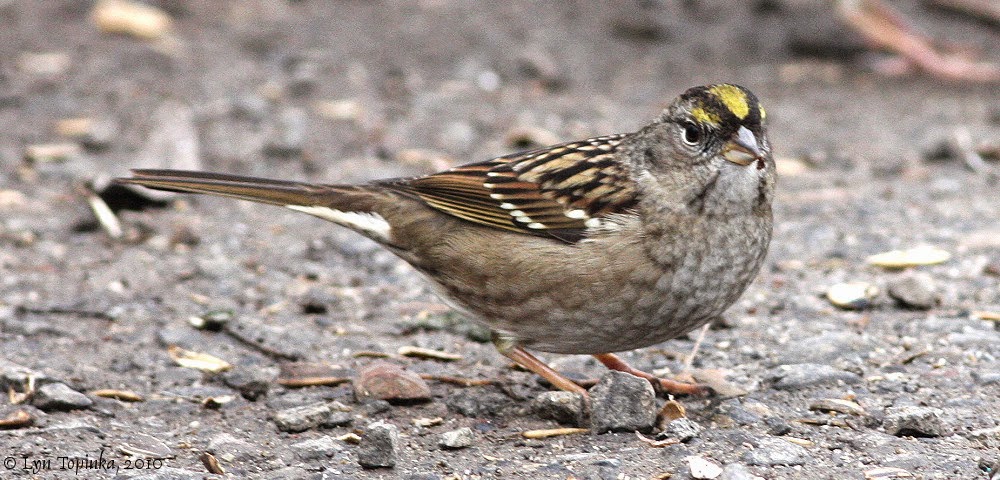
Golden Crowned Sparrow

We saw a lot of birds today, but the one that got both of us excited was the Golden Crowned Sparrow (Zonotrichia atricapilla). This is a large sparrow that migrates up and down the Pacific coast. They summer in Alaska and winter in Mexico. We found it on its migratory journey south, when it stopped at the Don Edwards Wildlife Area. Another “Life Bird” for us, meaning that we had never seen this bird before in our entire lives.

Golden Crowned Sparrow (Zonotrichia atricapilla)

Chinatown

We went to Chinatown for a fun lunch. We chose a Chinese restaurant and were sitting there eating, when a large, noisy Chinese parade started up out on the street. This was a cultural celebration of Taiwanese Independence, celebrating the anniversary of the fall of the Qing Dynasty in China and the installation of the Chinese Nationalist Party in Taiwan. There were musicians, beauty queens, dignitaries, ROTC type soldiers, banners, small individual dragons and finally one long, huge golden dragon with about twenty people inside of it. Very impressive. One lady left the parade to offer Robert a piece of hard candy.

After lunch, we found a Chinese jewelry store and Berry bought some green jewelry made from jade.

We found a Chinese Book Store and Robert bought a book called “High Level Xiangqi”, a book about Chinese Chess.

Our vacation has been great fun. The Golden Crowned Sparrow in the salt marsh was just more icing on the cake. We got back to the Holiday Inn and began packing everything to fly home. Robert took a needed nap.

Robert and Berry

photos courtesy of wikipedia, dereilainn

Saturday, October 4, 2014

Hummers

Anna’s Hummingbird

Today we worked the Grizzly Wildlife Area near Suisun, California. Someone had released a large, domesticated white rabbit into the wildlife area. It was not afraid of humans and was sitting next to the gate, as if waiting for its owner to come pick it up.

We walked slowly down a path and Berry found a pile of tail feathers from a pheasant. She put them in her bag.

A brightly colored, male Anna’s Hummingbird (Calypte anna) perched on the top branch of a bush, about six feet off the ground. Where there is a handsome man, there will be females. We saw the white throated female nearby.

a male Anna’s Hummingbird (Calypte Anna)

René Primevère Lesson, a traveling French ornithologist, named the “Anna’s Hummingbird” after Anna Masséna, the beautiful Duchess of Rivoli in the 1800s.

a female Anna’s Hummingbird (Calypte Anna)

The Black Chinned Hummingbird

Berry remembers that the Black Chinned Hummingbird (Archilochus alexandri) perched on a bush and stared at her for about five minutes. We do not have these species of hummingbird in the Memphis area. And the hummers that we have do not stare at you like this.

Black Chinned Hummingbird (Archilochus Alexandri)

We are now back in San Fransisco. We will bird tomorrow in the giant marsh near here and then fly home on Monday.

Robert and Berry

photos courtesy of wikipedia

Friday, October 3, 2014

The Sacramento River Wildlife Refuge

Sacramento River Wildlife Refuge

Today we drove down a lot of country roads on the way to the Sacramento River Wildlife Refuge. We birded boat ramps, agricultural canals, river levees, farm fields, parks, muddy ditches along the road, any area with trees or bushes, empty parking lots, busy graveyards and maternity hospitals. We are always on the look out for birds.

We have seen most of the birds on today’s list during other birding trips. Some of the birds we have hardly ever seen. Some we have seen many times. It is a crapshoot. Let us meet the birds we saw today. Time for a little Q and A.

Question: Mr. Sandhill Crane, when did Robert and Berry see you ?

Answer: They have seen me in Florida in someone’s front yard. They traveled to Nebraska in the freezing cold weather to see me. And today, two of us were standing in a dirt road and Berry spotted us as they drove past.

Sandhill Crane (Grus canadensis)


Question: Mr. Eurasian Collared Dove, why are you so distinctive among doves ?

Answer: I am similar in size to the Rock Dove you see in big cities, but my feathers are rather more white like the Turtle Dove. What makes me immediately identifiable is the black collar on my neck, from which I get my name.

Eurasian Collared Dove (Streptopelia decaocto


Question: Mr. Golden Eagle, what do you eat ?

Answer: I usually eat whatever I can catch. Rabbits, marmots and ground squirrels. I have been known to consume roadkill. If I am near water, I sometimes eat fish. I have even been known to attack a full grown deer.

Golden Eagle (Aquila chrysaetos)


Question: Mr. Greater White Fronted Goose, where would you like to visit in the United States ?

Answer: I do my heavy courting in Siberia and sometimes in Greenland. I have one of the largest ranges of any species of goose in the world. When I come to the United States, it is mainly west of the Missisippi River. I hang out in wetlands and farmlands. My kids want to go to Disney World in Florida, but we have not been yet.

Greater White Fronted Goose (Anser albifrons)


Question: Mr. Ruby Crowned Kinglet, why are you not wearing your Ruby Crown ?

Answer: I am wearing my olive green feathers and look here at my wing bars. Of course, you can see my white eye rings. As your question stated, you cannot see my red crown, because I am not agitated right now. Step in front of me in line and you will see the tiny ruby colored feathers on the top of my head flare up. Showing my bright red crest is a way of signaling displeasure or excitement.

Ruby Crowned Kinglet (Regulus calendula)


Question: Mr. Bushtit, how do you defend yourself, being so small ?

Answer: I cannot push people around in a bar. I am a lover, not a fighter. I flit constantly in the branches of thickets. Never alone and never quiet, I twitter even as I fly around, moving constantly. Robert saw me hanging upside down, prying a bug out of a pinecone. But I never sit still. That keeps me from becoming dinner on someone else’s plate. Bye, now!

Bushtit (Psaltriparus minimus)

Question: Mr. White Faced Ibis, when was the last time Berry saw you ?

Answer: I remember seeing Berry in New Orleans. It was before Katrina. I was standing in City Park and she had a spotting scope. I think I also saw Berry in Florida, inside the Everglades. This time, it was in California, inside the Sacramento River Wildlife Refuge at the end of the Autotour. She and I are becoming quite an item. Don’t tell Robert.

White Faced Ibis (Plegadis chihi)


Question: Mr. Ring Necked Pheasant, do you have a passport ?

Answer: My origins are somewhere in ancient China. Now I live quite naturally in east Asia. In some european countries, royal gamekeepers installed me in official game preserves for the enjoyment of rich people. When you see me now in the United States, it is either in Florida, where Robert and Berry saw me on a birding trip, or in California, where they spotted me dashing out in front of their car in the Sacramento River Wildlife Refuge. I get around.

Ring Necked Pheasant (Phasianus colchicus)


Question: Mr. Black Necked Stilt, can you find pants that will fit you ?

Answer: As you can see, I have extremely long, thin, pink legs. This is so I can forage in deep water. In addition to today, Robert and Berry see my legs when I am wading in the muck inside the Maxwell Waste Treatment Plant on Second Street in Memphis. Besides, my legs are quite lovely, so why should I cover them up with pants ?

Black Necked Stilt (Himantopus mexicanus)


Thanks to everyone who participated in today's interviews.

Robert and Berry

photos courtesy of wikipedia

Thursday, October 2, 2014

Warm Temperatures in Central California

Woodson Bridge Wildlife Area

After a “hotel” breakfast, which was not much of a breakfast, we headed east from Corning, Ca. toward the Woodson Bridge National Wildlife Area, another stop on the Sacramento River. We birded first at the City Park next to Woodson Bridge. We seem to have a lot of luck finding excellent birds at City Parks. We stood still and looked up and the trees were busy with birds.

We saw a great number of Acorn Woodpeckers (Melanerpes formicivorus) here, but we got very excited when one of them turned into a Nuttall’s Woodpecker (Picoides nuttallii). The back of the bird is patterned like a black and white ladder, so we say a bird like this is “ladder-backed”. Nuttall’s is only seen in the western United States. This was also a life bird for us. This was very exciting.

In the river next to us, large fish were jumping completely out of the river. Across from us on the other bank of the river, a woman was muttering to herself. She seemed to be pressing something into the ground with her feet. Berry thought she may be psychotic. Robert wondered aloud why she was not in a hospital. This is a birding blog, not a social problem forum. A strange interlude, no doubt.

  • Northern Mockingbird
  • Red Shouldered Hawk
  • House Finch
  • White Crowned Sparrow
  • Western Scrub Jay
  • Western Meadowlark
  • Dark Eyed Junco
  • Nuttall’s Woodpecker
  • Acorn Woodpecker
  • Red Shafted Northern Flicker
  • European Starling
  • Belted Kingfisher
  • Turkey Vulture
  • Black throated Gray Warbler
  • Yellow Rumped Warbler
  • Black Phoebe
  • Common Raven

Black Butte Lake

Leaving Woodson Bridge, we traveled southwest to Black Butte Lake. We actually followed a police car down the country road toward the lake. The squad car stopped at the scene of a bleeding man sprawled in the gutter. The poor fellow had been cut somehow, an accident or a fight. The police stared hard at us as we drove slowly past. This was just another strange interlude.

The lake itself seemed to be in the throes of a nasty drought. The lack of water caused by the drought meant the lake level was forty feet lower than normal. We walked on the beach, which used to be the bottom of the lake. We walked to the boat ramp and used our spotting scope to look at the Western Grebe(Aechmophorus occidentalis) and American White Pelicans (Pelecanus erythrorhynchos) in the water. Leaving the lake area, driving toward Orland, Ca. we passed more irrigation canals. In some the water was moving slowly and in others we clocked the water at 5 miles per hour. Poking into the canal, we spotted a Lesser Yellow Legs (Tringa flavipes) and several Killdeer (Charadrius vociferus).

  • Savannah Sparrow
  • Western Grebe
  • American White Pelicans
  • Lesser Yellow legs
  • Wild Turkey
  • Acorn Woodpecker
  • Black Throated Gray Warbler
  • Killdeer

Thermalito National Wildlife Reserve

We drove past a large, square body of water, probably agricultural in nature. There were a lot of Western Grebes (Aechmophorus occidentalis) here. We also birded the agricultural fields and their canals for about 45 miles going southeast to the “Thermalito Afterbay Outflow”. This area is part of the Oroville National Wildlife Reserve. On the adjoining Feather River, which runs through the Reserve, we saw huge fish jumping out of the water. Our literature says that the salmon begin running in the Fall, so we believe the huge fish jumping were probably salmon.

In the reeds along the bank, we watched a beautiful Green Heron (Butorides virescens) poke its beak in the water and pull up something to eat. This is one of Robert’s favorite birds. Down the bank a bit, a large Great Blue Heron (Ardea herodias) waded through the green muck near the bank and stabbed the water with its enormous beak, snagging a small fish to eat as well.

  • Red Tailed Hawk
  • American Coot
  • Pied Billed Grebe
  • Western Grebe
  • Red Winged Blackbird
  • Killdeer
  • Savannah Sparrow
  • Great Egret
  • Great Blue Heron
  • Osprey
  • Green Heron

This area has a warm, Mediterranean climate. There is a breeze but there is not the cold of the coastal areas that we experienced earlier. After another great day birding in central California, we stayed at the Holiday Inn in Oroville, Ca.

Robert and Berry

photos courtesy of wikipedia

Wednesday, October 1, 2014

Birding Central California

Redding Sewage Treatment Plant

At the Redding Sewage Treatment Plant, Berry called it the Redding Sausage Treatment Plant, there was a small misunderstanding after signing in. Berry signed in then they wanted her to sign a legal release, in case we fell in the sewage tailing ponds and drowned. After that, we starting walking past the mechanical equipment to go to the tailing ponds and two fellows drove up in a white pickup and said we weren’t supposed to be there. Berry and I rolled our eyes.

We walked around the tailing ponds and looked for birds and we looked outside the fence, too. We identified the little gray Bushtit in a special area that was posted with a sign warning us not to disturb the endangered “Valley Elderberry Longhorn Beetle”. The hungry birds could eat the beetles, we imagined, but we were supposed to control our appetites. In this area we also saw the California Quail. There are plenty of these dashing birds here. Note on this bird, the distinctive tear drop shaped topknot, which is diagnostic.


Anderson River Park

We were actually looking for a different place when we found this huge city park alongside the Sacramento River. The way we birded this park was to drive our vehicle a few feet then halt. When we both had finished looking at a bird, Robert would then drive a few feet more. We made our way through the entire park this way, step by step. This is a huge city park with horses to ride, a microlight aircraft launching pad, frisbee golf, large empty places, access to the Sacramento River and a fishing dock. We found some great birds right off the roads or right next to the parking areas.

  • Acorn Woodpecker
  • Mountain Bluebird
  • Stellar’s Jay
  • Trumpeter Swan
  • Wood Duck
  • Canada Geese
  • Northern Mockingbird
  • House Finch
  • Brewer’s Blackbird
  • Chipping Sparrow
  • Mallard Duck
  • Killdeer
  • Western Scrub Jay
  • Yellow Billed Magpie

The Yellow Billed Magpie was eating seeds on the ground next to the road. It is a very large bird, larger than a Bluejay. It has a bright yellow beak and a bright yellow eye-ring. We were very proud to have spotted this one, because the Yellow Billed Magpie is much more difficult to see than the Black Billed Magpie. It is a rarer bird. A great find for us.


Battle Creek National Wildlife Area

Along a road inside the Battle Creek National Wildlife Area, we stopped the car and focused in on something moving in the bushes beside the road. It had an orangish red stomach and white flecks on its black wings. It was easy to determine that this was the Spotted Towhee. It looks just like the Eastern Towhee that we see near Memphis, except the wings are flecked with white paint.

At one point we spotted a large flock of Wild Turkeys, walking along pecking at the ground. There were at least twelve large birds in this flock. Berry noted that it was closing in on Thanksgiving and that these turkeys were pleasingly plump.

We were tired and hungry so we had lunch at Sandy’s Specialties in Cottonwood, Ca. It is mainly a specialty baking place, but we got some pretty nice sandwiches there.


Sacramento River Agricultural Canals

Back across the river and down the highway a bit, we moved into agricultural fields. There were fruit trees and nut trees and olive trees in neat rows along the country road. To irrigate these fields, there are large concrete canals full of water running up and down the middle of California. There is a road perfectly situated next to the canal, such that we could drive alongside the canal and look for birds inside. Here is where we found one of the best birds of the day, the American Dipper.

  • American Dipper
  • Greater Yellow Legs
  • Say’s Phoebe
  • Savannah Sparrow
  • Canada Goose
  • Red Necked Grebe
  • Western Scrub Jay
  • Great Egret
  • Common Merganser
  • Prairie Falcon
  • Killdeer

The American Dipper

We found a bird today that we had been looking for most of the trip. We stopped next to a mountain stream once to look for it. The American Dipper is the only songbird which goes swimming. It wades in mountain streams and searches for food. It has a special oil in its feathers to stay warm. It has a small flap of tissue which closes to allow it underwater. Needless to say, when we found it today, at the edge of one of these large concrete agricultural canals, we were happy. We watched the one, when its mate appeared. Berry and I were dancing in circles.


Casa Ramos

Ai Caramba ! Berry and I went to a Mexican restaurant in Corning, Ca. for dinner tonight. I ordered something called Molcajete and then told the waiter, “Muy picante, por favor” which means, “Very spicy hot, please”. The waiter proceeded to take off the top of my head. I started sweating profusely. I quickly ran out of unsweetened iced tea. Berry asked if I were okay. Yes, I was. I had asked for very spicy hot food and I got it. Casa Ramos is an excellent little restaurant, if you’re ever in Corning, Ca.

Robert and Berry

photos courtesy of wikipedia

Tuesday, September 30, 2014

From the Pacific Coast to the Center of the State

Point St. George Wildlife Area

Being birders, we got up at an ungodly hour and drove to the wind swept sea cliffs of Point St. George near Crescent City, California. It was dark as we sat in the car and discussed which birds we might see. A poor homeless man was sleeping in his car next to us in the parking area to this birding site. Our movement and our lights woke him up and he suddenly drove away. We do not usually interact with the strange people we meet while birding. We leave them alone and we wish to be left alone.

The Wind

The wind was cool with heavy gusts. We stood on top of a huge grassy butte which stretched out into the ocean. The birds were just waking up among the rocks and sand beaches below. We used our spotting scope on top of the hill to identify birds. The one of us with the scope would holler diagnostic descriptions to the one with the bird guide, yelling over the sound of the wind. The wind was never so strong that it disturbed the balance of our spotting scope. On some birding trips, one of us has to hold down the legs of the spotting scope to steady the scope and keep the view of the bird through the scope from vibrating violently. The wind this morning was very strong. Robert needed a muffler for his neck. Berry thought gloves would have been a good idea.

Bewick's Wren


  • Western Sandpiper
  • Bewick’s Wren
  • Black Turnstone
  • Surf Bird
  • American White Pelican
  • Brown Pelican
  • Western Gull
  • Black Oystercatcher
  • Double Crested Cormorant
  • American Coot
  • Red Necked Grebe
  • European Starling
  • Brewer’s Blackbird
  • Common Raven
  • Great Blue Heron
  • Turkey Vulture

Lunch in Weaverville

After eating breakfast at the hotel, we said goodbye to the Pacific Ocean and headed east toward the mountains and into the large forests of north central California. Again, we encountered the narrow, winding roads talked about in an earlier post. We had lunch in the small mountain town of Weaverville. Robert ordered chili with onions rings, only to discover too late that there was no meat in the chili. Berry had an open faced turkey sandwich. We kept driving and came to the the Trinity River and its reservoir behind a dam in the Shasta-Trinity National Forest. The drought in the western United States is severe. Here are some photos of the reservoir so low that the boat ramp is out of the water. Thirty feet out of the water.


Lewiston Lake

The river below the dam had plenty of water. Berry found a boat ramp with blackberries and a wild apple tree. The birding here was fantastic with many interesting birds. We finally saw the Bald Eagle right above our car. We saw three Mute Swans in Lewiston Lake in California, that is one yesterday and three today. We kept checking the identification of each of these very carefully, because none of them are supposed to be here. Our life bird of Lewiston was the Bullock’s Oriole.

  • Canada Goose
  • Bullock’s Oriole
  • Common Merganser
  • Yellow Rumped Warbler
  • Mute Swan
  • Scrub Jay
  • Great Egret
  • Bald Eagle
  • Red Shafted Northern Flicker

Redding

Our day ended in Redding, CA. There Robert bought a pair of tennis shoes and Berry replaced a leaky styrofoam cooler. We are both exhausted. We just birded the northern California coast from San Francisco to Crescent City and next we will bird our way back down the center of the state. Thanks for enjoying our birding adventures with us.

Robert and Berry

photos courtesy of wikipedia, bshelton

Monday, September 29, 2014

Northern Most Point of our Birding Vacation

In Eureka

Breakfast at Kristina’s was steak and eggs with A1 sauce for Robert and scrambled eggs and bacon for Berry. Breakfast is one time on a birding vacation when it is not the journey, but the destination.

As we drove down highways, through thick, forested stretches of Redwood, or down country roads, looking for birds, we got into a thousand interesting philosophic discussions. What was the source of all the homelessness in the Pacific Northwest ? We see a lot of homeless men and women in northern California. Why do the local girls here wear their hair in ratty, unattractive gnarls painted sky blue, flamingo pink or just plain orange ? Even little old ladies here dye their hair bizarre colors. And why do restaurants always fry seafood items, instead of baking them or broiling them or poaching them ? It is easier, of course, to bread something and fry it, but our preferences ran from being covered in nuts and broiled to my favorite being poached carefully in white wine. The discussions went on in the car between the pauses to look at birds.

Humboldt Bay

At Humboldt Bay National Wildlife Refuge, we saw one of the best birds of the day. This was the Chestnut Backed Chickadee. We stopped the car on a downhill slope because the tree beside us was buzzing with life. There were fifty of these little chickadees eating berries off this tree. We see the Black Capped Chickadee in the eastern United States and the Carolina Chickadee at home in the South. This was a Chestnut Backed Chickadee.

Patrick's Point

At Patrick’s Point State Park, we saw a Golden Retriever walking with its master through the fern strewn Redwood forest. When we first saw the light brown dog, Berry thought it was a Mountain Lion. There are warnings everywhere in northern California for the dangers of Mountain Lions, which eat you, the dangers of rutting Elk, which gore and stomp you and the dangers of Tsunamis (this is an earthquake zone ), which drown you. They put signs at the high water limits of hypothetical tsunamis from hypothetical earthquakes. In the middle of all the excitement, we found a pair of Brown Creepers climbing a tree trunk.

Crescent City

On Highway One outside of Crescent City, a California Highway Patrol cop turned his lights on to signal me to pull over and let him by. I did so and he roared forward, but it really spooked me. The squad car roared around a truck and arrested a third car in front of the truck. Just as this was happening, a group of young teens standing on the shoulder of the highway tossed a skateboard at the truck in front of me. The large wheels of the truck crushed the skateboard for them. We had to dodge the remains of the destroyed skateboard which tumbled across the highway. It was a weird birding interlude.

We took a well needed afternoon nap at a nice hotel in Crescent City, California. It was listed in our GPS as a Hampton Inn, but when we got here it was something different. Using the spotting scope from the balcony of our room, we saw seals playing in the water near boulders in the ocean, poking their cute noses up for air, then descending again. On shore there was a squirrel so still that Berry thought it was a statue. Brown Pelicans were floating sleepily on the waves. Then Berry spotted three grebes, which led to a discussion of the difference between the Clark’s Grebes and the Western Grebes. The three in front of us in the Pacific Ocean were Western Grebe because their beaks were grayish, not yellowish.

Robert and Berry

photos courtesy of utahbirds, wikipedia

Sunday, September 28, 2014

Ukiah Sewage Treatment Plant

Ukiah, California has a really cool sewage treatment plant. You may ask why we might want to go to a sewage treatment plant. In the process of sanitizing raw sewage, the treatment plant fills large pools with already filtered water in tailing ponds , in which microscopic matter settles slowly to the bottom of the pool. The water is green with algae and the organisms which eat algae. Ducks, herons, geese and grebes are all attracted to the biologically healthy aspect of these places. Bodies of still water attract ducks. So, we always look for these tailing ponds in every city, wherever we bird. One of the best is in Aransas, Texas, where we saw an alligator underneath the boardwalk.

We drove to the Ukiah Waste Water Treatment Plant immediately after breakfast. We carried binoculars and our spotting scope into the plant gate. They ask that you sign in, which we did. Then, we made our way back to the four large tailing ponds. There were hundreds of birds there. They each can be placed into these specific groups.

  • Blue Wing Teal
  • Green Wing Teal
  • Ring Necked Duck
  • Scaup
  • Black Scoter
  • Common Merganser
  • Killdeer
  • Double Crested Cormorant
  • Eared Grebe
  • Pied Bill Grebe
  • American Coot

In the rear of the treatment plant, behind the tailing ponds and behind a chain link fence, there were blackberry thickets and mature pear orchards. All this along a wooded stretch of the Russian River. The fruit attracted various birds, such that the leaves were a-twitter with activity. We edged ourselves closer to the fence. It was delicious.

  • Yellow Rumped Warbler
  • Black Phoebe
  • Tree Sparrow
  • Turkey Vulture
  • Nashville Warbler
  • Black Throated Gray Warbler
  • Fox Sparrow

This afternoon was travel time. We drove north from Ukiah, California and finally to Eureka, California. This journey was a dizzying series of zigzags and cutbacks on the highway in the mountains. If another car got in front of you, the convenient turn-outs were designed to allow other cars to pass. One selfish driver today had a train of eight other cars behind it. Back and forth. Up and down. The cars seemed to be painfully hooked together because the one driver refused to pull over.

Here are some photo graphs from our birding journey so far. Please enjoy them.

The is a shot of the Golden Gate Bridge from the north side near Sausalito.

This is Robert in front of an enormous Redwood tree in Austin Creek Natural Area.

This is Berry standing beside a huge Redwood tree in the Cazadero woods.

We took a picture of the very large Elk in Point Reyes State Park. We took the photo from the safety of our car.

This is Arch Rock in the ocean near Point Reyes State Park. Remember, we are birders and not photographers.

This is the "Blow Hole" rock formation at the Russian Gulch State Park. Berry almost fell in.

This is a sea cave also in the Russian Gulch State Park. Berry tried to push Robert in.

This is the Chandelier Redwood Tree, which cost five dollars to see. We thought it was a rip off, because there are other, better and larger, holes cut into other Redwood and Sequoia trees further north. Probably five bucks, too.

Robert and Berry

photos courtesy of rfowler, bshelton