Monday, December 31, 2012

The Battle of Vicksburg

   We traveled up the Mississippi River from Louisiana into southern Mississippi and birded the hardwood lowlands of Vicksburg. In historical times, it was here that Johnny Reb fended off the yankee incursions of the drunken general into the heart of the Confederacy. It was two huge military assaults by Grant himself that led to nought in Vicksburg, but nought led to a heartless siege which after forty days finally starved out the rebels and effectively decided the Civil War. And now, in present times, the quiet of the woods is only broken by the rattle of woodpeckers.

Vicksburg in 1863
Vicksburg Today

   The Red Headed Woodpecker (Melanerpes erythrocephalus) is a medium sized woodpecker. This black bird is easy to identify due to its head being totally red. The secondary feathers on the trailing edge of each wing are white, making this beautiful bird unmistakable. His uniform of three colors - black, red and white.

Red Headed Woodpecker
   The Yellow Bellied Sapsucker (Sphyrapicus varius) is black, but the black on its back is broken with white bars. Its black head has white lines down the side. The red on its head is split between its throat and the crown of its head. The yellow on its breast and upper belly is difficult to see. Adult males have a red throat; females have a white throat. Its uniform is camouflage, the colors in a disruptive pattern on this bird. And as we shall see, this woodpecker can be very loud.

Yellow Bellied Sapsucker

   The battle started when the Red Headed Woodpecker and the smaller Yellow Bellied Sapsucker occupied the very same tree. The Red Headed Woodpecker was situated above the Yellow Bellied Sapsucker when Berry spotted them. Suddenly and all at once, the Red Headed Woodpecker attacked the Yellow Bellied Sapsucker by swooping out and diving on the bird below. As far as Berry is willing to say, this was an unprovoked attack. Who was on whose tree ? That remains the historian's question.

   The unprovoked assault sent the Yellow Bellied Sapsucker into a frenzy of squawking complaint. This could be heard throughout the forest. It was very loud and initiated a series of aerial tiffs where both birds flew up to meet each other. Then more squawking. The Yellow Bellied Sapsucker followed the Red Headed Woodpecker from tree to tree, irritating him, chasing it away. The Red Headed Woodpecker who had started the fight could not stop the fight. It went on for some twenty minutes, as we witnessed it. History can indeed repeat itself many times in the hardwood forests surrounding Vicksburg.

   We left the woods and headed home to Memphis.

Robert and Berry

photos courtesy of unknown, dsherony, colleen, bshelton

Sunday, December 30, 2012

Westward to Louisiana

   I impressed Berry that, even before we had eaten breakfast, we saw the Black Skimmer (Rynchops niger) on a sandbar. It is black with a distinctive black and orange beak. Its lower mandible is longer than the upper, making it look like a broken beak. This is intentional. As the bird flies close to the water, the longer underpart of the bill is skimmed through the water to scoop up fish. Today we saw them sunning themselves in the sand.

Black Skimmer

   The Mississippi Gulf Coast is a major breeding ground for the Least Tern (Sternula antillarum) and here we spotted lots of them. They were sharing the beach with larger Ring Billed Gulls (Larus delawarensis), some excessively active Willets (Catoptrophorus semipalmatus) and the skittish if not frantic flock of Sanderlings (Calidris alba). We even counted four Herring Gulls (Larus smithsonianus) in the mix. These are large brown birds that reminded me very much of the Great Skua (Stercorarius skua) that we saw in Iceland.

   Five Ruddy Turnstones ((Arenaria interpres) pecked at things on a sandbar. They use their beaks to turn over stones in search of nibblable snacks. The Forster's Tern (Sterna forsteri) we recognized because they nest near our hometown of Memphis, Tennessee. Further out on the surf were Greater Yellowlegs (Tringa melanoleuca). They were in deeper water because they have longer legs and long straight bills. Floating out in even deeper water were two Common Loons (Gavia immer).

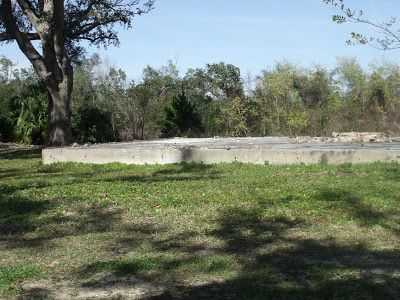
   It is cool here, but it is the wind that cuts through you. The hurricane damage is still evident. There are empty lots for sale and open foundations where there used to be houses. If people want to rebuild in the path of inevitable hurricanes, homeowners insurance must be astronomical.

Post Hurricane

   We birded down the coast and into the swampland of the Louisiana Purchase. Dat's near N'Awlins, so went into town to have lunch. I spoke twice to my sister by phone and she texted me several times today. She is resting. She suggested that if we were in New Orleans, we should eat at Mandina's restaurant on Canal Street. She used to live there and knew the place. We did not try the homemade Turtle Soup. I had the Trout LaFitte (trout with spicy shrimp etouffee on top). Berry had Fried Eggplant with Marinara Sauce and Shrimp Remoulade. What a tip! What a treat! We were stuffed, so the complimentary Bread Pudding came with us for later.

Mandina's Restaurant

   After an exhausting day birding on the beach, we traded seats and Berry drove on up into Baton Rouge. Tomorrow our journey takes us back up into Mississippi and we'll follow the river to Vicksburg. Then north to Memphis.

Robert and Berry

photos courtesy of tfoote, bshelton, neworleansonline

Saturday, December 29, 2012

Birding Around Pascagoula

   We stayed the night in a hotel in Alabama, so when we started birding we were poking around a fleet of fishing boats in southern Alabama. From a concrete platform behind a fishing boat repair shop, we used the spotting scope to identify Common Loons (Gavia immer) in the harbor. The sandblasting and pounding of the repair people did not seem to disturb the Brown Pelicans (Pelecanus occidentalis) which were buzzing around them. A pleasant surprise was our first tern of the trip, the Common Tern (Sterna hirundo) which buffetted themselves from the cold by standing together on the sand facing away from the wind.

   Right over the border into Mississippi and next to the ocean is the Grand Bay Wildlife Refuge. Huge nests were built on top of tall electrical pylons. We examined each nest for its resident bird, probably Osprey (Pandion haliaetus), but did not see anything. Either we were late and they had already flown off, or else, quite possibly, the birds were hunkered down inside the nest to get out of the wind. It was windy all morning.

Osprey Nest

   We saw flocks of American Robins (Turdus migratorius) enjoying the temperate climate of southern Mississippi. On a side street, we saw more than 50 of them pecking at the wet ground. Inside the tangles of a bush I saw the distinctive black head of the Eastern Phoebe (Sayornis phoebe). We were thinking that probably the bird-of-the-day was going to be a pair of White Winged Doves (Zenaida asiatica) we saw on Chevron Corporation property. That is until we went to Gautier, Mississippi.

   At the Gautier City Park and Bird Sanctuary we saw these birds:

Orange Crowned Warbler

   That Orange Crowned Warbler (Oreothlypis celata), which for us is a life-bird, we caught late in the afternoon, flitting first in a gumball tree, then it moved on top of a small shed so we could get a good look at it.

Here are some photos we took in southern Mississippi:

Great Blue Heron
Fishing Boat Returning from Shrimping
Eastern Bluebird

Robert and Berry

photos courtesy of bshelton, rfowler, glasley

Friday, December 28, 2012

Van Harris' Column in the Commercial Appeal

   Van Harris interviewed Berry and I for his column in the Commercial Appeal. Here is a link to the on-line version of the story.

Van Harris's Article

   Robert

Green Winged Teals and Horned Grebes

   We got up early and grabbed some carbohydrates and coffee. Then the weather turned rainy and overcast. We drove to Ross Barnett Reservoir in central Mississippi. The spillway at the dam was delightfully alive with Ring Billed Gulls (Larus delawarensis) and Great Egrets (Ardea alba). The egrets were also roosting in the trees below the spillway. Several Great Blue Herons (Ardea herodias) were fishing along the bank, right alongside the human "fisher-people".

   At the Pearl River inlet into the reservoir, there is a handsome waterfowl restoration project. Long stretches of grass beds that extend into the lake. Here we spotted a whole flock of Green Winged Teal (Anas crecca carolinensis) trolling for food. Identification marks on the Green Winged Teal include a large green spot on their head and a cream colored vertical stripe on either side. The only other bird that looks like it is the American Widgeon, which has the green spot on its head, but even in the rainy haze which covered the lake, the cream colored vertical stripe is "diagnostic" for the Green Winged Teal.

Green Winged Teal

   It started raining heavily at this point, so we cut out and drove very fast through the pouring rain to eat lunch at the excellent Crescent Grill restaurant in Hattiesburg. Crab cakes and seafood crepes. Bonne bouffe, as the French say. Good grub. It was very nice to get in out of the rain.

   Pascagoula is a small town on the gulf coast of Mississippi near Alabama. Here we saw a flock of American White Pelicans (Pelecanus erythrorhynchos) on the surface of the intercoastal waterway. They feed in groups by lining up on the water and paddling slowly forward, churning up the little fish in front of them. Brown Pelicans (Pelecanus occidentalis) dive bomb into the ocean to catch fish. American Whites are more civilized. They are white birds, totally white as they sit on the water, yet as they rise into flight, you see the trailing edge of their wings is black. Here is a picture of an American White Pelican.

American White Pelican

   From our hotel based in Mobile, Alabama, we drove across the bay to finally replace the Delorme map of Mississippi we had lost. We had dinner right next door at Wentzell's. I had bacon-wrapped shrimp and Monterey oysters. Berry had she-crab soup and their famous Stuffed Crabs. Delicious. We updated the blog back at our hotel and crashed for the night.

Robert and Berry

photo courtesy of rfowler, mkainickara, awilson

Thursday, December 27, 2012

Noxubee

   Berry and I loaded up the car and left Memphis around 9am, after placing the hound in the doggie spa. He likes it there, which is good. When the kennel worker took Cosmo back to his room, Cosmo tugged on the leash. We drove south down past where the snow was on the ground. On the way we saw Turkey Vultures and the American Crow. Heading southeast on Lamar to Highway 45 we went to Starkville, Mississippi where we ate lunch.

   On the way, we heard frightening medical news about my sister. I spoke with other family members and decided to continue our birding trip. My sister herself texted me back in the afternoon that she was resting and feeling better. Berry and I are both still worried.

   The Noxubee Swamp is located inside a huge pine forest. The hardwood bottomland is punctuated at the water with beautiful cypress trees. There were lots of Double Crested Cormorants swimming in the water and drying off on limbs in the water. The only other bird we saw in the water were American Coots.

Noxubee Swamp

   There was a nice wooden boardwalk through the cypress trees to a pier on Lake Noxubee. As we walked slowly down the boardwalk, we heard woodpeckers all around us. The first woodpecker that we identified was the Red Cockaded Woodpecker (Picoides borealis). This bird is endangered and only lives in a handful of places, Noxubee Swamp being one.

Red Cockaded Woodpecker

   Berry identified the next two woodpeckers for us. The Red Headed Woodpecker (Melanerpes erythrocephalus) was high in a tree near the hospitality building. The Red Bellied Woodpecker (Melanerpes carolinus) she saw along a forest path that we took. It was woodpeckers all day long. We heard a lot more than we saw.

   We had coffee in a cute place called Cuppa in Louisville, Mississippi. It got dark quickly and we drove to Jackson, Mississippi. Berry and I lost our Delorme map of Mississippi. It was in the car, but we searched everywhere and cannot find it. Yikes! After dinner, we went to a bookstore to replace it. The helpful clerk there said that they did not have any Delorme maps of Mississippi. She had maps of everywhere else but not of the state of Mississippi. Go figure.

Robert and Berry

photo courtesy of kegley, rfowler

Sunday, November 25, 2012

Finished Birding Kentucky

   After intentionally sleeping late, we packed the car and had breakfast. It was great birding this weekend, but it was time to take the backroads of Tennessee down to Memphis town.

   Berry and I always debate what might be considered the "Bird of the Day" and even the "Bird of the Trip", if we spot a truly rare oddity. Nominations for the "Bird of the Trip" include the mysterious gray Swamp Sparrow, the busy little Ovenbird, the yellow American Goldfinch, and the woodland acrobat White Breasted Nuthatch.

   The award goes to the Yellow Crowned Night Heron that we saw on the roof of the marina in Kuttawa, Kentucky. This is normally a secretive bird, which forages in shallow water late at night, yet we saw it in broad daylight and scoped it easily. The photo yesterday did not do it justice. Thanks to all the birds who entered, but did not win.

"Bird of the Trip"

   Home sweet home and glad to be there. Kentucky was beautiful. Berry and I would like to go back there some day.

Robert and Berry

photo courtesy of wikipedia

Saturday, November 24, 2012

Still Birding Kentucky

   We woke up early and it was freezing cold outside. No precipitation, but frigid and unwelcoming. There were several basketball teams staying in the hotel. I made a waffle for breakfast, then hot coffee paved the way to reach our car. Brrrr. It was cold.

   Berry spotted our first Black Vulture of the trip, on our way to the Peabody Wildlife Management Area. And a superb looking bird it was. Jet black with white fingers on its wingtips. Majestic as it soared. We had only seen Turkey Vultures before this.

   The Peabody Wildlife Management Area has hundreds of cattail-rimmed tailing ponds, swampland reclaimed from previously concluded mining operations. We saw huge flocks of Red Winged Blackbirds, swirling above the reeds. Robert found a Swamp Sparrow near the water. And a beautiful Red Shouldered Hawk swooped down and away from us. It was busy, birdwatching there.

   They do not want hunters to shoot Wild Turkey in Kentucky. Please don't. And if you do, there is a fine of $500 in the state of Kentucky. $500 for shooting a Wild Turkey.

DON'T SHOOT A WILD TURKEY

   This really is "coal country" and we saw plenty of gigantic coal trucks traveling in convoys, enormous mining operations with trains carrying away the coal and the smokestacks of a very large power plant receiving shipments of coal. When the harsh wind and bitter cold of the Peabody swamps got to be too much, we found a small cafe and had coffee and did a crossword puzzle to get warm.

   We often drive down country roads and non-descript side roads in search of birds. Once we skirted along the side of an Army Small-Arms Firing Range and found an Ovenbird in the underbrush. Some local fellow was driving covered wagons drawn by mules along the road. We heard the tapping of a Hairy Woodpecker, then followed him as he went slowly up the tree. In that same part of the forest I saw a Yellow Rumped Warbler.

   The cadence of wildlife venues (swamp - forest - shooting range ) did not facilitate us eating a sit-down lunch in a civilized restaurant. So Berry and I got fried chicken, an apple, almonds and drinks at a grocery store and toted them into the woods. This was a stroke of genius, because we stopped briefly between birds, in front of a handsome cattail-framed bog, and ate lunch in the car.

   Here is a list of all the birds we saw today.

   Making our way south past the Cumberland River, we birded the northern part of the Land-Between-the-Lakes. This is a large peninsula surrounded by two large lakes. Starting at the shoreline there at Kuttawa, we saw the American Coots. These were the first birds willing to swim in the very cold water since we got to Kentucky. It is appreciably warmer in Kuttawa than in the coal filled mountains around Bowling Green. The town of Kuttawa has a nice stand of hardwood trees, so we saw the American Goldfinch nibbling gumballs on a gumball tree. House Finches were playing in the dirt. A Hairy Woodpecker and a Red Bellied Woodpecker both tapped on the trees in front of us. A wonderful White Breasted Nuthatch climbed up and down the trunk.

   In the harbor there at Kuttawa there is a large heron rookery. November is between the breeding seasons, but we did identify both the Great Blue Heron and the Yellow Crowned Night Heron. Ring Billed Gulls patrolled the open water. I photographed one Yellow Crowned Night Heron on the roof of the marina.

Yellow Crowned Night Heron

   Our final stop of the day was at an Elk and Bison Preserve. This entailed a short car tour allowing us to see and photograph wild elk and bison. There were supposed to be 43 elk and 70 bison in the preserve. The very large elk were in small pockets of two or three. The bison formed a large herd, when we saw them. Very impressive. You had to stay inside your car for safety.

Elk
Bison
Robert and Berry

photos courtesy of bshelton, rfowler

Friday, November 23, 2012

Birding Central Kentucky

   After feasting Thanksgiving with family and friends, Berry and I are birding the coal hills and lakes of central Kentucky. We drove north of Nashville on I-65 and it started raining. That was actually conducive to birding because the rain seems to fix the birds in place. They hunker down in the trees and bushes till it stops raining.

   We turned east on Highway 100 and immediately started battling huge coal trucks on the little highway. We saw Eastern Bluebirds on the electricity lines. These we call "America's Bird" because they are red, white and blue, yet in the wintery blow and steady rain, they looked drab and weathered. American Kestrels and Mourning Doves rested on the phone lines while it sprinkled.

   The culture of the people changed when we went across the border into Kentucky. Coal is big here. I saw a bumper sticker, "If you don't like coal, don't use electricity." The Shakers, a small religious sect of Charismatic Christians are established here. We also started seeing large blue stars, called "Barnstars" painted on the front of the houses here. These are decorative and can mean good luck in the German community here. We made several photos of such stars.

Blue Star
Star of Sticks

   We travelled past Scottsville to the Barren River Lake State Park. There were fishermen in boats on the lake, but it was very cold. Berry and I parked in the parking lot at the Marina. We aimed the spotting scope at the edge of the lot and suddenly there were a variety of birds.

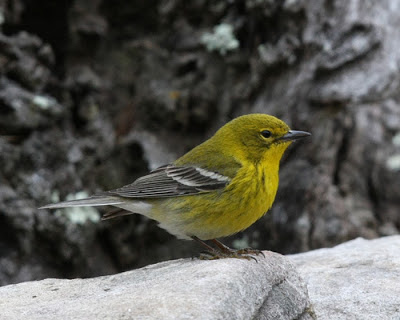
   There were two Pied Billed Grebes swimming and diving in the freezing cold water. Temperatures will drop to 26 degrees F this evening. The Pine Warblers, Tufted Titmice, and Carolina Wren were huddling in the warm cozy underbrush, out of the water and out of the wind coming from the lake. It was two different bird strategies contrasted nicely for us. We however got quickly wind-blown and fled to the diner for coffee and heat.

Pine Warbler

   Berry and I think all the people in Kentucky are very nice. One patient boater waited for us to get off the ramp. Even the state prisoners in orange jumpsuits on work detail, raking leaves in the sun in the State Park with their armed guard watching, waved at us and smiled pleasantly. What a charming birding spot with happy prisoners. And cynical us, we had just joked about there being a fictional place called "Crystal Meth Cafe" in the last small town.

   After lunch we travelled to the Mammoth Springs Cave State Park. We did not go spelunking. We were there for the birds. Birds do not live in caves. But when we went across the Green River on a two-car ferry, we saw this small cave with bars across the entrance to keep people's curiosity from getting them in trouble.

Small Caged Cave

   In the late afternoon we drove to Nortin River Dam, then headed south to the lovely college town of Bowling Green, where we shared a pizza. We are exhausted but this has been a great day of birding.

Robert and Berry

photos courtesy of bshelton, naturefriendmagazine, rfowler

Monday, October 29, 2012

Wedding Birds

   Berry and I were invited to drive to a small inn in eastern Tennessee called Evin's Mill. This is a small grist mill. It has several cabins where we stayed. Everyone in the family was there. This was a very special occasion.

Evin's Mill

   My sister married her long-time boyfriend in a beautiful stream-side ceremony. The musicians were in place. The official was dressed in black. His wife held a Bible. I had an orange wool cap in case it got too cold. There was a huge party afterwards in the main building.

My Sister's Wedding

   The skies were overcast, which Berry and I like for birding. It keeps down the glare of the sun. I heard a rattling sound above me. Just above the cabins I spotted a Red Bellied Woodpecker tapping at things in a wooden perch.

Red Bellied Woopecker

   There was a large pine tree next to my brother's cabin. When he listened carefully, he heard a Carolina Chickadee singing "chick-a-dee-dee-dee..." just above him.

Carolina Chickadee

   And finally driving home, further south by way of Murfreesboro, we drove past a small bog. Berry identified there a Belted Kingfisher, staring down into the water, a little late in the season.

Belted Kingfisher

   It was a beautiful ceremony. Joined in matrimony. Well done. We offer our best heart-felt wishes to both of them on their birding adventures to come.

Robert and Berry

photos courtesy of dpancamo, kthomas, mbaird, lillianb and www.evinsmill.com